Omdia’s viewpoint: The application of new optical fibers is accelerating, and market competition is becoming increasingly fierce
The latest report from market research firm Omdia shows that the demand for bandwidth from AI and the $42.5 billion US Broadband Equity Access and Deployment (BEAD) program is forcing the information superhighway to adopt unprecedented upgrade solutions. All network links are facing pressure, which has spurred the development of new fiber optic cable technologies and deserves continuous attention.

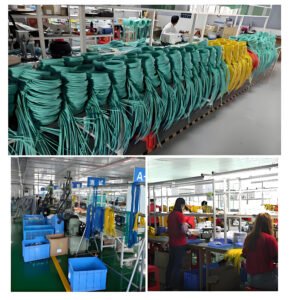
Omdia’s viewpoint: The accelerated application of new optical fibers is leading to increasingly fierce market competition (Figure 1)
Fiber optic upgrade: increase single link bandwidth
To enhance the bandwidth capacity per unit area, new types of optical fibers are constantly being introduced. For example, in order to meet the requirements of data center interconnection and other scenarios, new high bandwidth optical cables (such as single cable over 6000 cores) and 200 micron outer diameter optical fibers (finer than traditional 250 micron optical fibers) have been put into use. This type of technology was deployed before the launch of ChatGPT-4, but demand will continue to grow in the future, and higher core fiber optic cables will become a necessity.
200 micron outer diameter optical fibers are also deployed in underwater networks to increase bandwidth capacity. The submarine cable industry is currently deploying the first network using multi-core optical fibers. Google announced that it will use dual core fiber in a submarine cable system from Taiwan, China, China, the Philippines and the United States, which will be built in cooperation with China Telecom, Innove and AT&T, and is expected to be put into use by the middle of 2025.
Long distance trunk networks also increase fiber optic capacity by increasing the number of channels per unit area. We are currently upgrading the network configuration to support C-band and L-band transmission, thereby doubling the single fiber capacity compared to the previous generation. At the same time, the industry chain is actively exploring other available frequency bands to further enhance transmission potential.
The market competition among fiber optic manufacturers is becoming increasingly fierce
Omdia pointed out that the market competition in the fiber optic cable industry has significantly intensified, as evidenced by two press releases in August 2024.
Firstly, Corning announced that it will reserve 10% of its global fiber optic production capacity for Lumen, a fiber optic operator focused on AI data centers, to provide it with a new generation of AI fiber optic systems. It is reported that this is a two-year agreement.
During the same period, Prysmian won a lawsuit against Sterlite and received a compensation of $96.5 million. One of the competition focuses between the two parties is the contract related to the BEAD program in the United States.
Hollow core fiber: a noteworthy technological breakthrough
Hollow fiber optic uses air as the transmission medium, which has lower losses, smaller nonlinear effects, lower dispersion, and a theoretical delay reduction of 30% compared to traditional quartz fiber optic. It also supports full frequency band transmission. Given that Microsoft acquired Lumensity in 2022, the market is looking forward to the implementation and maturity of this technology.
Despite the superior performance of the new fiber optic technology, its large-scale application still relies on industry chain collaboration. Omidia pointed out that in future reports, the current status and commercialization milestones of these technologies will be tracked.